January 6, 2015
With the new year upon us, businesses in every industry are plotting creative strategies to engage their customers. But what exactly does it take to develop loyalty, foster long-term relationships, and keep customers consistently engaged? In our view, it’s delivering memorable customer moments to create streamlined, consistent, and exceptional experiences.
Take Apple for instance. Each time I purchase an Apple product, I am reminded of how pleasant the experience is: I can easily open the no-fuss packaging (did you know Apple has a team of dedicated box openers?), I am enthusiastically greeted (in multiple languages) when turning on my device for the first time, and I’m offered simple and seamless integration to my other Apple devices. As in the words of Steve Jobs, “You’ve got to start with the customer experience and work back toward the technology — not the other way around.”
More often than not, our consultants walk into projects where requirements are defined without adequate consideration of how it affects the overall customer experience. However, this lack of focus on customer experience is not expected to last long, as Gartner predicts that by 2017, as much as 50 percent of product investments will be redirected to customer experience innovations. Essentially, focusing on customer engagement hones in on the most important relationship in your business: the one between you and your customers. At Bluewolf, we fully illuminate this relationship for our clients through the Customer Experience (CX) Map.
What is a CX Map?
A CX Map provides a holistic view of all the touchpoints or interactions users have with a product or service. It will identify pain points, triggers, and "moments of truth" where the process is blatantly broken, or where the experience has not been aptly considered.
Why are CX Maps Useful?
Mapping out the customers' experiences allows for a central point of reference for all customer touchpoints. It harmonizes views across the organization of what customers want and how they engage with various channels to help identify opportunities to innovate. With a firm handle on the CX map, businesses are much more successful and efficient when diving into an implementation that delivers customer-focused business outcomes.
How is a CX Map developed?
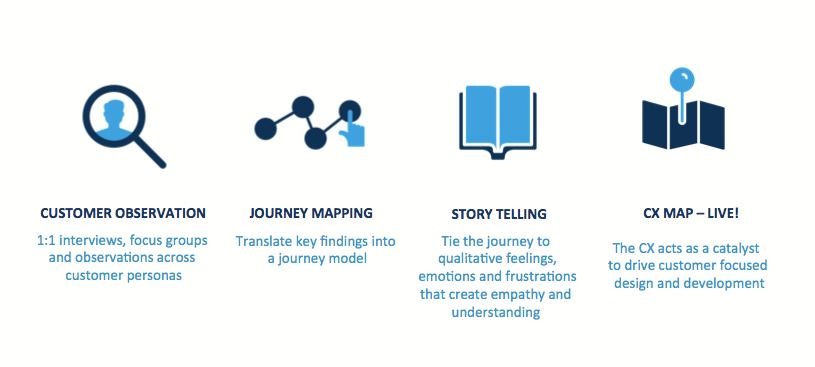
At Bluewolf, customers are asked to share in-depth experiences to inform our research for CX mapping. One-on-one interviews, focus groups, and observations provide insight and data to help develop the various personas that interact with a particular product or service. Our key findings from this process are then translated to a journey model tied to qualitative indicators, such as emotions and feelings. Ultimately, this process tells a story through the lens of the customer to help inform areas of opportunity.
Organizations that deeply understand their customers’ experiences with their brand can identify weak areas and innovate to deliver a holistic, integrated, and exceptional experience across all touchpoints. Today’s always-on customers are empowered like never before. Improving your brand’s customer experience will increase satisfaction and boost loyalty. The empowered customers will turn into advocates who can spread awareness and send business referrals to further amplify your brand.
Contact your client advisor to begin plotting your journey. Or learn more about optimizing customer experience in our Essential Guide to Customer Obsession.