April 10, 2014
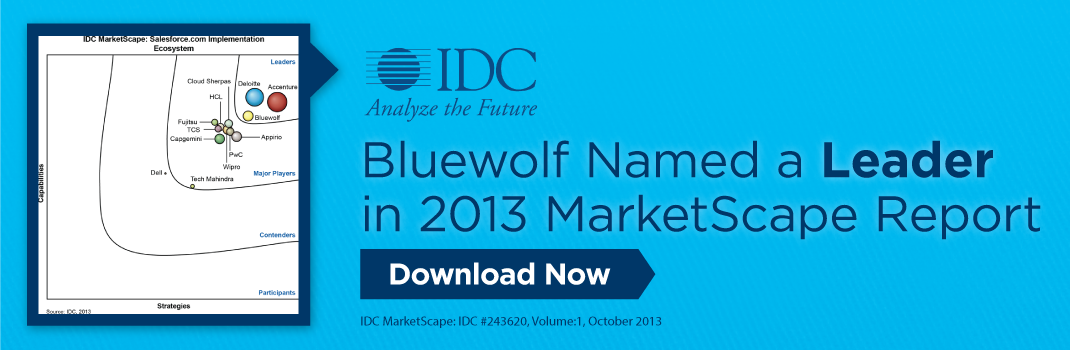
The latest IDC study demonstrates that among salesforce.com’s five main partners, three of them did not exist fifteen years ago: Bluewolf, Appirio and Cloud Sherpas. Salesforce.com supports this emphasis, by classifying two of those organizations — including Bluewolf — as its “Global Strategic Partners.”
Given the dramatic rise of cloud computing, how can we explain that most of the big players in IT have failed to capitalize on one of the industry's greatest transformations?
Having conducted more than 60 Salesforce projects over the past six years, I see three main explanations for this failure:
- Salesforce projects are shorter and consume fewer resources than before.
Big service companies favor long-term projects requiring heavy maintenance. In the 2000s, they were all about CRM projects where each implementation was billed for man-years, thereby costing millions of euros for technological adaptation, developments and maintenance.
Salesforce.com revolutionized this approach. Technological constraints have disappeared for the client and are now fully managed by the editor. Moreover, 90% of the implementation process is set up simply by configuration, without developments. These transformations reduced the need for external resources. On average, a first version of the solution is operational in less than three months. Finally, the needed profiles for this transformation are more business-oriented rather than technological-oriented. This new rhythm goes against big companies’ interests, as the operational shift from their traditional business model is difficult to integrate. Most of these companies are now delayed in the transformation process — they are moving backwards, letting new, agile players invest the market. - Historical IT big players do not know how to address SMB and SME needs.
The transformation process described above is also beneficial to SMB and SME. Indeed, they are now able to use the same tools as giant enterprises’ at an affordable price. SMB and SME need advice as well as business and technological guidance. Let down by the big players, most of them turn to specialized partners with extensive CRM experience. Thus, with more than 4500 Salesforce customers, a partner like Bluewolf can quickly implement best practices to help client derive maximum benefit from the cloud. - Passionate Salesforce consultants do not want to work in those structures anymore.
Salesforce represents agility as well as the ability to help companies transform their business models and better engage their customers. How can you participate in this transformation process if you belong to a traditional IT company organized in silos and aligned on a rigid, traditional model?
The best consultants are looking for something else. That’s why at Bluewolf we offer:
- #GoingSocial program to promote employee visibility on social networks through knowledge sharing and engagement. Moreover, all of our consultants’ abridged resumes are available online on Bluewolf’s website.
- Training programs combining technology and business
- Direct access via Salesforce to our expertise bases providing our best practices (we have more than 1000 client success stories) combined with collaborative functions via Chatter to ensure that a consultant is never left alone in addressing a client issue
- A gamification approach integrated to our Salesforce tool which enables them to win prizes (iPads, Dreamforce passes, lunch with our CEO, team happy hours, personal brand building on social networks, and many more.)
This participatory culture is recognized by Gartner: “Bluewolf has a very strong and distinctive culture that permeates the organization. It is very appealing to accounts looking for creativity and energy”.
This culture enables us to attract and maintain the best Salesforce consultants who possess very high functional expertise combined with deep knowledge. Of course, as a Bluewolf member, I based my analysis upon my personal experiences. Ultimately, however, I deeply believe that the consulting market is transforming and its leaders will be the companies that combine agility, technological expertise, as well as exceptional business consulting ability.