December 12, 2013
Lead nurturing is designed to build relationships and trust with prospects in a way that is both consistent and relevant to their needs and interests. However, the name ‘lead nurturing’ shouldn’t just be limited to those new to your database. Lead nurturing is for contacts too. Consider your whole database (contacts and leads) and determine a strategic way to segment and target based on your objectives & goals of the campaign. So, why do lead nurturing? In this three-part blog series we’ll break down the fundamentals of lead nurture campaigns and benefits to your organization.
The amount of daily content, dispersed over multiple communication channels can be overwhelming for most people. As a marketer, how are you rising above the noise to differentiate your brand as a thought leader in your industry? The ability to engage individuals with the right content at the right time, offers a level of personalization to your prospects and gives you an upper hand to competitors.
Demand Gen Report found that marketing departments leveraging lead nurture campaigns are experiencing the full benefits:

Lead nurturing requires strategic planning of segmentations types, workflows, and user-specific content to reach the full potential of a campaign. This will take an effort, but don’t get discouraged. Listen to this webcast and read the recap below to hear from Marketo’s Jon Miller and Bluewolf’s Corinne Sklar on how to drive meaningful content for your nurture programs and how to prove these programs effective.
Managing Data Quality
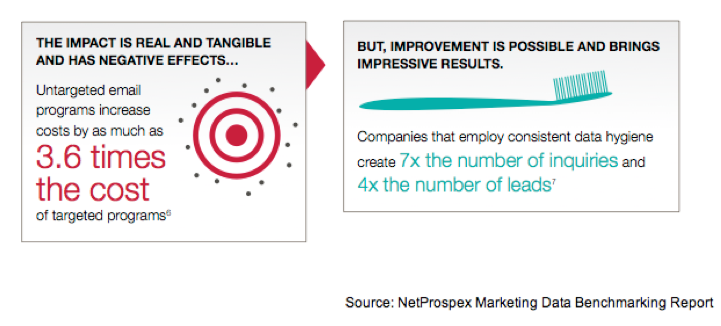
From Bluewolf’s recent State of Salesforce report, it was found that 25% of companies say that data is their #1 business challenge. To a marketer, data quality isn’t exactly the sexist topic to discuss. But before you can even thinking about building out strategic marketing efforts, such as lead nurture, you must have a strategy for data upkeep and ongoing enrichment. You can’t effectively communicate with your database with dirty data.
According to research by SiriusDecisions, an average 25% of B2B marketing databases are inaccurate. SiriusDecisions also found that the longer organizations house inaccurate data the more expensive it became to fix. Data is at the heart of database marketing—here are three ways ensure data quality in your org:
- All-in-one view
For a true single and accurate view of the customers/prospects your data must be all-in-one system. The most efficient and effective organizations have full visibility between their marketing automation tool and CRM. In addition to this integration consider your social data, where is this being tracked and how is it being responded to. When all of your tools and systems are streamlined to a single view, it can also bring a natural alignment and better communication between sales and marketing. - Marketing & IT alignment
Marketing should primarily works with IT to build a data appense strategy and governance.Consider integrating a data cleansing tool with your marketing automation and CRM that can help with the upkeep and accuracy of data. The data of your contacts and leads are ever changing, so this strategy and upkeep in ongoing. Align your marketing goals with those of IT to drive an agreed upon solution. - Data entry best practices
Align with your Sales and Service teams to agree on best practices and training for all users entering data into your system. Marketing is usually focused on form-filled data but it is critical to also have a structure in place for non-form-filled data. Consider how a rep on a desktop versus a rep on their mobile device is going to enter data. Inaccurate data entries, whether through list buy, form fills, or user inputted data, will undermine your marketing efforts and ROI.
Getting Better Engagement
Increasing engagement in emails begins with building trust. “If you haven’t earned a subscriber's trust, they won’t open or click on your emails,” advises Jon Miller. Build trust by delivering relevant & helpful content at an appropriate cadence. Consider the ways you can drive engagement through active opt-in, and the risks of sending emails to those who did not opt-in.
In Marketo’s recent Definitive Guide to Engaging Email Marketing, it states that on any given day, the average customer will be exposed to 2,904 media messages, will pay attention to 52 and will positively remember only four. How are you going to ensure that you are one of those four memorable messages? Yelling louder than others won’t work. Instead, speak strategically and relevantly to your audience. Batch & blast does not work, we know that. Jon Miller said it best, “No one wakes up and says, ‘Boy I hope I get an email blast today!’” So build targeting and segmentation into your email strategy. Smaller batches of relevant sends will lead to more engagement. Also consider the number of emails and the cadence or frequency of those emails.
Lead nurture cadence:

Consider combining open rates, click throughs, unsubscribes, and conversions into one master metric, enabling marketers to judge how effectively each piece of content is engaging prospects and customers over time. This will determine the best way to iterate on the segmentation and evaluate the efficacy of content. Segmentation of a database can vary depending on your specific product or service, length or complexity of sales cycles, and sometimes as simple as geographical region.
- % Saying Content Customized By Category is More Valuable
- By Industry: 82%
- By Role: 67%
- Doers vs. Buyers
- Job Function
- By Company Size: 49%
- By Geography: 29%
Source: MarketingSherpa
In the next installment of Lead Nurture Tactics & Tips, we’ll highlight the keys to creating engaging content for your campaigns.
To see how the top marketers are constructing their marketing strategies in the new Bluewolf guide, The Three Pillars of Modern Digital Marketing.