August 24, 2015
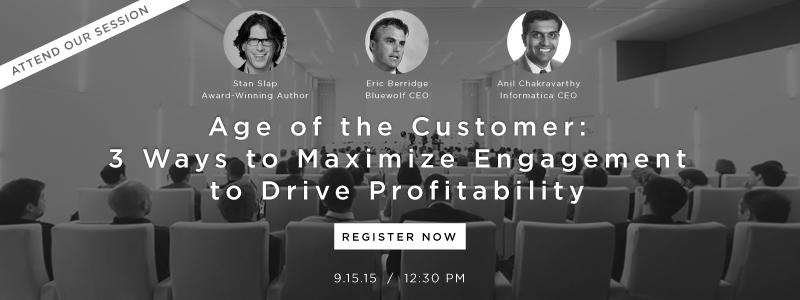
With Dreamforce only four weeks away, I decided to sit down with our CEO, Eric Berridge, to chat about his upcoming super session and his advice for attendees for first timers and seasoned veterans alike.
EP: Your super session explores the impact of culture and employee engagement in shaping an organization. Can you expand on that and give us a preview?
EB: Focusing on four core business outcomes—acquisition, expansion, retention, and cost reduction—is essential to increasing profitability. In order to achieve these outcomes, companies need to invest in data, design, and culture to inspire employee and customer engagement.
Just think of the loyalty companies like Apple and Google receive from their customers—their product delivery and design, predictive algorithms, and customer focused cultures provide an incredible user experience and in turn, users respond with deeper engagement with their products and services. My goal is to explore the opportunities presented by data, design, and culture, and how companies can practically invest in these strategies to improve their bottom line.
EP: The session features a few guest speakers — Anil Chakravarthy, Informatica CEO, and Stan Slap, author of Under the Hood. What can you tell us about them?
EB: I first saw Stan when he was giving a keynote at a conference last March and I was struck by the sheer force of his personality. I knew that I wanted to have him on stage with me at Dreamforce. His insights about understanding and harnessing the power of an employee culture to achieve business transformation really resonated with me.
Bluewolf and Informatica have been technology partners since September 2014. Coupling that with Informatica’s leadership in the world of data, it was a no brainer to invite Anil to weigh in on the future of data in the global marketplace. You’ll see us touch on data analytics as a business transformer, and its increasing ability to predict and answer questions of emotional satisfaction in consumer relationships to solve problems like retention and identify new opportunities for expansion.
EP: We’ve touched on data and employee culture. How does design fit in with both of these?
EB: The best designers are able to strike a balance between simplicity of use and complexity of functionality. Intuitive design is informed by data—user preferences, habits, attitudes—while design defines how we absorb and organize data sets that determine business strategy, on an individual and enterprise level.
Great design requires an empathetic connection with end users to determine how to make their lives easier and simpler. A thorough understanding of your employee and customer cultures increases the potential impact of new features and products significantly. All three elements — data, culture, and design — are driving towards the same thing: better quality of life.
EP: Eric, thank you so much for giving us an exclusive look into your session. Before we wrap, I just have one more question. Dreamforce is bigger than ever this year. As someone who has attended every Dreamforce since its inception, what advice would you give to this year’s attendees?
EB: With so many sessions available, it’s a good idea to have a general outline that hits upon the things you want to learn about most. That being said, the best approach is to be open and receptive to new people and new ideas. Salesforce has an amazing community around it. Don’t be afraid to introduce yourself and ask questions. Everyone attending, from CEO to entry-level, is there to connect and learn from one another.
Eric’s Dreamforce super session, “Age of the Customer: 3 Ways to Maximize Engagement to Drive Profitability” is September 15 at 12:30pm PT. Register now to reserve your seat.