April 29, 2015
Actionable analytics are indispensable for an effective marketing team. At Bluewolf, we hold a meeting called "Metric Mondays" every — you guessed it — Monday, during which we discuss our lead funnel and examine metrics related to each stage, including conversions of marketing-driven inquiries to opportunities. We’ve been able to track our inquires all the way through the funnel to gain visibility into our top performing campaigns, and, in turn, better inform our future marketing investments. Our CRM (Salesforce) is a key part of this puzzle, as it gives us visibility into campaign attribution. Below are our top recommendations for implementing campaign influence tracking in your organization:
- Create campaigns in Salesforce.
Each campaign owner must create a dedicated campaign for each marketing channel. We use a parent-child campaign hierarchy to nest channel campaigns under an umbrella campaign, which is usually a consolidated effort around an asset launch or major event. We also use a “type” picklist on campaigns to be able report on effectiveness by channel type. See an example of our set-up below. While this may seem like a lot of effort, it’s the best way to get an apples-to-apples comparison of channel effectiveness and will help you create a business case for marketing spend.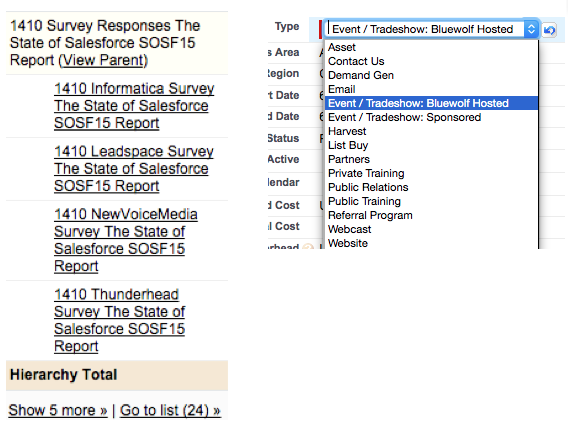
- Pass campaign IDs via query strings.
For each promotional channel, we use a unique URL that passes the related campaign ID via a query string. We still only need one landing page (with a form) for each campaign, but the campaign ID in the URL overrides the campaign ID in the form so that each form fill gets associated to the correct channel campaign in Salesforce.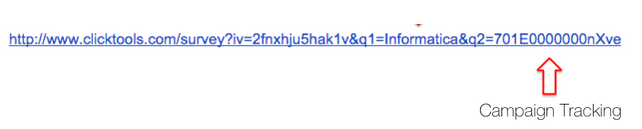
- Use Contact Roles on Opportunities.
Using Contact Roles on Opportunities is critical to close the loop. We ask that our Sales organization add all contacts involved in an Opportunity to the “Contact Roles” related list.
- Track campaign influence on Opportunities.
Native Salesforce functionality will pull the campaigns from the Contact Roles into the Campaign Influence section on the Opportunity. You can customize your Campaign Influence settings per your sales cycle length, business process, or other criteria to determine which Campaigns get added. At Bluewolf, we use Campaigns that have the status of “Responded,” 180 days from when the Contact Role is added to the Opportunity.
- Create campaign influence Models.
This requires a blog post of its own, but native Salesforce Campaign Influence is fairly limited in its abilities. The Salesforce Campaign Influence reports basically take the entire dollar value of the Opportunity and give the full value to each campaign associated to the Opportunity. This is challenging because the reporting of Campaign Influence dollar value is inflated due to double counting. Luckily, there are several apps that solve this problem. At Bluewolf, we use Full Circle CRM for campaign influence reporting. Full Circle allows you to create three different attribution models based on your business process to report on campaign influence per model.
Full Circle has been effective for us because it allows a lot of customization. You can enable it to pull in “first campaign touch” if you want a sense of how marketing first brought the account into CRM. You can also change the weighting distribution based on Contact Role type, Campaign type, timing, and so forth.
- Give visibility with dashboards.
The best way to give visibility of Marketing campaign attribution is via a dashboard. We have several dashboards set up that report on on attribution by campaign name, campaign type, etc. This is a good high-level view and supplements our weekly metrics meeting that I mentioned above.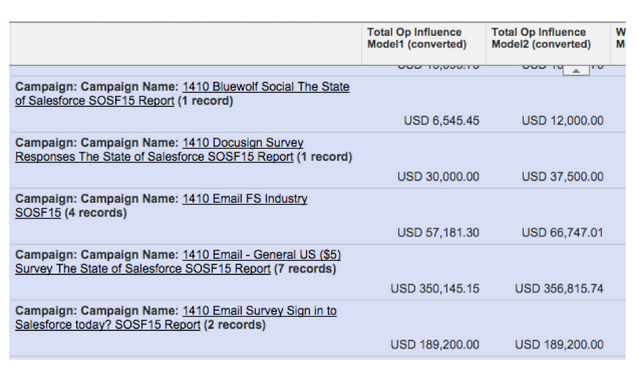
I hope our team's process has provided your marketing team actionable steps to measure and report on campaign influence. Interested in learning more about attribution and proving marketing ROI? Get in touch, or tweet me @Saleemaf.
Look out for upcoming blogs in this series to go behind the scenes for an in-depth look at our marketing team's process and initiatives. Subscribe to receive updates directly in your inbox.


